
Categories
Fitness

Effective Leg Workouts at Home with Minimal Equipment

Leg Workout with Minimal Equipment

In today’s fast-paced world, many individuals struggle to find time for effective workouts, especially when access to a gym or extensive equipment may be limited. Fortunately, a comprehensive leg workout can be conducted with minimal gear, offering significant benefits for strength, endurance, and overall fitness. With just a few basic items, you can effectively target your leg muscles and enhance your physical health.

  • Introduction
  • The Importance of Leg Workouts
  • Essential Equipment for Home Workouts
  • Effective Leg Exercises with Minimal Equipment
  • Common Myths and Misconceptions
  • When to Consult a Professional
  • Frequently Asked Questions
  • Conclusion

The Importance of Leg Workouts

Leg workouts play a crucial role in overall body fitness. Strong legs not only enhance athletic performance but also contribute to better stability, balance, and mobility. Moreover, leg workouts engage some of the largest muscle groups in the body, facilitating improved metabolism and calorie burning. By incorporating regular leg exercises, you can fortify your lower body, prevent injuries, and enhance your daily function.

Essential Equipment for Home Workouts

While elaborate gym setups can be beneficial, they are not a prerequisite for a successful workout routine. The following items are recommended for minimal equipment leg workouts:

  • Resistance Bands: These versatile bands add variable resistance to exercises, enhancing muscle engagement.
  • Dumbbells: A lightweight set can add intensity to leg exercises without needing much space.
  • Sturdy Chair or Bench: A stable surface is useful for various exercises such as step-ups and tricep dips.
  • Yoga Mat: Provides comfort for floor exercises and enhances grip for certain movements.

Effective Leg Exercises with Minimal Equipment

Here’s a structured approach to a leg workout that can be performed in the comfort of your home:

  1. Squats: Stand with feet shoulder-width apart. Lower into a squat while keeping your back straight. Hold for a moment, then return to standing. Aim for 3 sets of 10-15 repetitions.
  2. Lunges: Step forward with one leg and lower your hips until both knees are bent at about 90 degrees. Alternate legs for 3 sets of 10-12 repetitions.
  3. Glute Bridges: Lie on your back with knees bent and feet flat on the floor. Raise your hips towards the ceiling to form a straight line from shoulders to knees. Hold for a few seconds, then lower. Aim for 3 sets of 12-15 repetitions.
  4. Resistance Band Leg Press: Secure a resistance band under your feet while seated. Push against the band while keeping your back straight, then slowly return. Aim for 3 sets of 10-12 repetitions.
  5. Calf Raises: Stand on an elevated surface with your heels hanging off the edge. Raise your heels as high as possible, then lower back down. Aim for 3 sets of 12-15 repetitions.

For those seeking a structured regimen, consider registering for this 30-day exercise program, which requires only 6 minutes of effort each day and delivers results comparable to traditional gym workouts.

Common Myths and Misconceptions

Many misconceptions surround leg workouts, particularly regarding equipment and effectiveness:

  • Myth 1: Heavy weights are necessary for leg gains. Truth: Bodyweight exercises and lighter weights can yield significant results when performed with correct form.
  • Myth 2: You must workout every day to see results. Truth: Consistency and rest are key; 2-3 times per week is effective.
  • Myth 3: Spot reduction is possible. Truth: Fat loss occurs uniformly throughout the body, not just in targeted areas.

When to Consult a Professional

While engaging in leg workouts is beneficial, certain conditions may necessitate the involvement of a professional:

  • If you experience persistent pain during or after exercise.
  • If you have a pre-existing injury that may affect your ability to perform leg exercises.
  • If you are uncertain about proper exercise techniques or routines.

Frequently Asked Questions

Can I achieve leg muscle growth with bodyweight exercises?

Yes, bodyweight exercises can effectively promote muscle growth when performed with proper form and consistency.

How often should I conduct leg workouts?

For optimal results, aim for 2-3 leg workouts per week, allowing time for recovery in between sessions.

Are warm-ups necessary before leg workouts?

Yes, warming up is crucial to prepare your muscles and joints for the physical stress of the workout, reducing the risk of injury.

Can I combine leg workouts with upper body exercises?

Absolutely! Full-body workouts can be very effective in enhancing overall fitness.

Should I use weights during leg workouts?

Using weights can increase the intensity of your workouts; however, bodyweight exercises are also effective, especially for beginners.

How can I track my progress?

Monitor improvements by tracking the number of repetitions, the weight used, or how your body feels during workouts over time.

Conclusion

  • Leg workouts are essential for overall physical fitness and function.
  • Minimal equipment, like resistance bands and dumbbells, can facilitate effective workouts at home.
  • Implementing a variety of exercises enhances muscle engagement and growth.
  • Seek professional advice if you encounter persistent pain or have concerns regarding exercise techniques.
  • Consider integrating a comprehensive program for guided and structured training.

Incorporating leg workouts into your routine will significantly enhance your fitness journey. For a simplified approach to exercising, explore the 30-day exercise program that requires just 6 minutes each day for noticeable results.

Author: John Angel
Related articles

Categories
Home Workouts

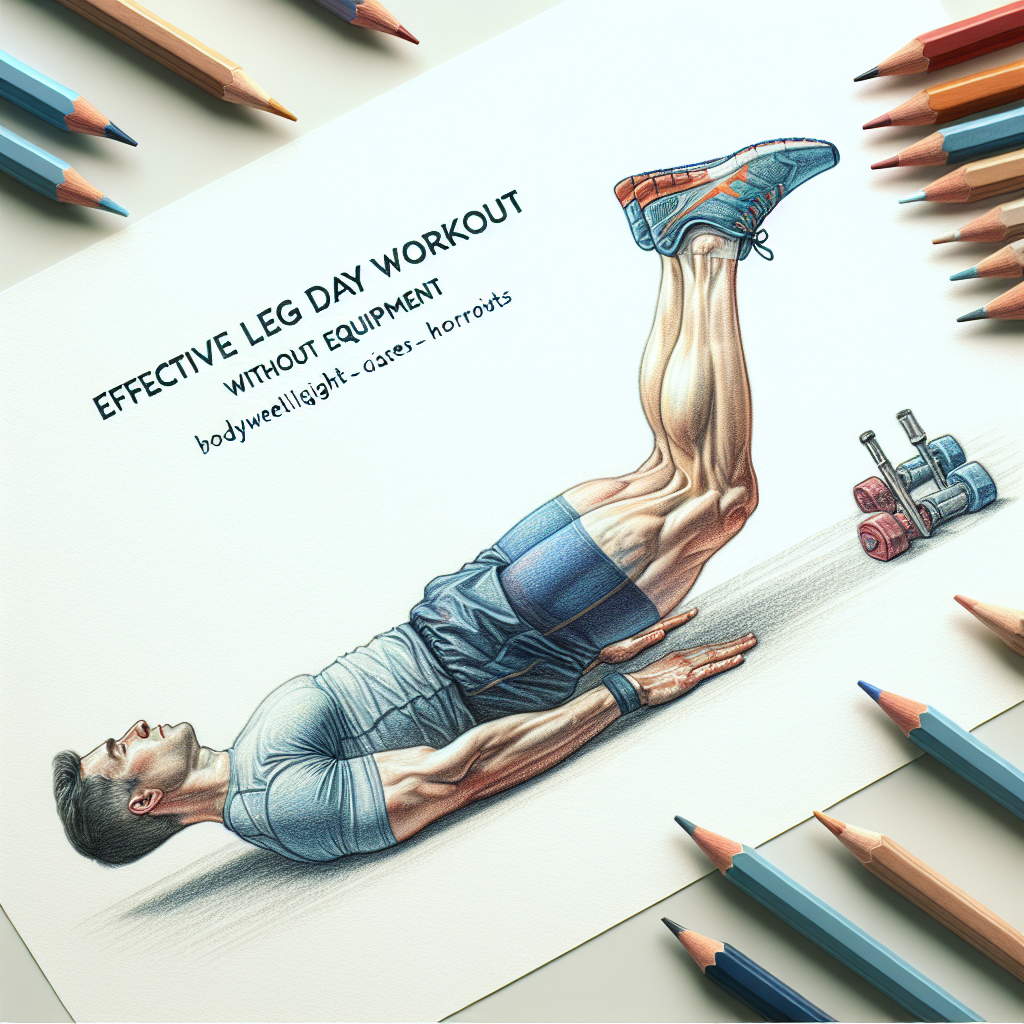
Effective Home Leg Day Workout Without Equipment

Leg day is often regarded as one of the most challenging yet rewarding aspects of a fitness regimen. Engaging in leg exercises not only strengthens the lower body but also promotes overall fitness. If convenience is a priority for you, performing an effective leg day workout at home without any equipment is entirely feasible. This article will guide you through a series of impactful bodyweight exercises that can sculpt your legs, improve coordination, and boost your endurance—all from the comfort of your home.

  • Understanding the Importance of Leg Day
  • Essential Bodyweight Exercises
  • Crafting a Home Leg Day Routine
  • Timing and Frequency of Workouts
  • Common Misconceptions about Leg Training
  • When to Consult a Professional
  • Frequently Asked Questions

Understanding the Importance of Leg Day

Leg day is foundational for any fitness program. Strong legs contribute to better balance and stability, which can enhance performance in various sports and physical activities. Furthermore, leg workouts burn considerable calories, facilitating weight management. By engaging the larger muscle groups of the legs, such as quadriceps, hamstrings, and calves, you improve your body’s overall metabolic rate, encouraging fat loss and muscle gain simultaneously.

Essential Bodyweight Exercises

To effectively work your legs without equipment, consider incorporating the following exercises into your routine:

  • Squats: A fundamental exercise that targets the quadriceps, hamstrings, and glutes.
  • Lunges: Effective for improving leg strength and balance while targeting multiple muscle groups.
  • Glute Bridges: Focuses on the glutes and lower back, contributing to overall leg strength.
  • Calf Raises: Essential for building strength in the calf muscles and improving ankle stability.
  • Wall Sits: A static exercise that develops muscular endurance and strength in the legs.

Crafting a Home Leg Day Routine

A well-structured leg day workout typically encompasses multiple exercises focusing on various muscle groups. Below, find an example routine that can be completed in approximately 20–30 minutes:

  1. Warm-up (5 minutes): Jumping jacks or light jogging in place.
  2. Squats (3 sets of 10-15 repetitions)
  3. Lunges (3 sets of 10-15 repetitions per leg)
  4. Glute Bridges (3 sets of 10-15 repetitions)
  5. Calf Raises (3 sets of 15-20 repetitions)
  6. Wall Sits (3 sets of 30 seconds to 1 minute)
  7. Cool down (5 minutes): Stretching exercises focusing on the legs.

For a more structured approach, consider registering for this free 30-day exercise program, which requires just six minutes of daily commitment yet delivers results akin to a gym routine.

Timing and Frequency of Workouts

To optimize results, aim to incorporate leg workouts into your weekly routine 1-2 times, allowing at least 48 hours of rest between sessions. This frequency is sufficient for muscle recovery and growth. Additionally, practicing some flexibility and mobility exercises on off days can aid recovery and enhance physical performance.

Common Misconceptions about Leg Training

Many individuals harbor misconceptions regarding leg day that may hinder their fitness progress:

  • Myth 1: Leg workouts lead to bulky muscles. Reality: Proper strength training generally enhances lean muscle mass rather than bulk.
  • Myth 2: Squats are harmful for your knees. Reality: When performed with correct form, squats strengthen the knees and surrounding structures.
  • Myth 3: You must lift heavy weights to build leg strength. Reality: Bodyweight exercises can be equally effective when performed correctly and consistently.

When to Consult a Professional

While exercising at home, it is crucial to monitor your body for any adverse reactions. Consult a qualified professional if you experience:

  • Persistent joint pain or swelling.
  • Severe muscle soreness that does not improve after a few days.
  • Difficulty performing exercises correctly due to physical limitations.
  • Any other signs that may indicate an underlying medical condition.

Seeking professional guidance can ensure that your workouts are safe and effective, helping you achieve your fitness goals efficiently.

Frequently Asked Questions

Can I really achieve results without any equipment?

Absolutely! Bodyweight exercises are highly effective for building strength and endurance.

How long should my leg workout take?

A focused leg workout can typically be completed within 20–30 minutes.

Do I need to warm up before exercising?

Yes, warming up increases blood flow to the muscles and reduces the risk of injury.

How often should I train my legs?

Training your legs 1-2 times a week is usually sufficient for most individuals.

Can I combine leg workouts with other muscle groups?

Yes, many people combine leg workouts with upper body or full-body routines for balanced training.

What is the best way to cool down after leg training?

Gentle stretching of the leg muscles is an effective way to cool down and promote recovery.

Conclusion

  • Leg day is essential for a balanced fitness regime.
  • Bodyweight exercises can be effective for leg training at home.
  • Incorporating variety into your routine enhances engagement and effectiveness.
  • Listening to your body is crucial for safe workouts and injury prevention.
  • Consult a professional if you experience pain or other concerning symptoms.

Take charge of your leg workouts today and experience the benefits firsthand. For an excellent starting point, don’t forget to register for the 30-day exercise program to enjoy an efficient routine that fits your schedule.

Author: John Angel

Related articles

Website analytics information

We use Google Analytics 4 for visitor statistics. Analytics cookies require your consent, which you can change using the button above. The data controller is ZDRAVÍ S ÚSMĚVEM s.r.o., company ID 29283329, contact podpora@revolucnicviceni.cz. Google processes browser, device and page visit information. We do not send form field values to Analytics. How Google uses information · Google Privacy Policy.